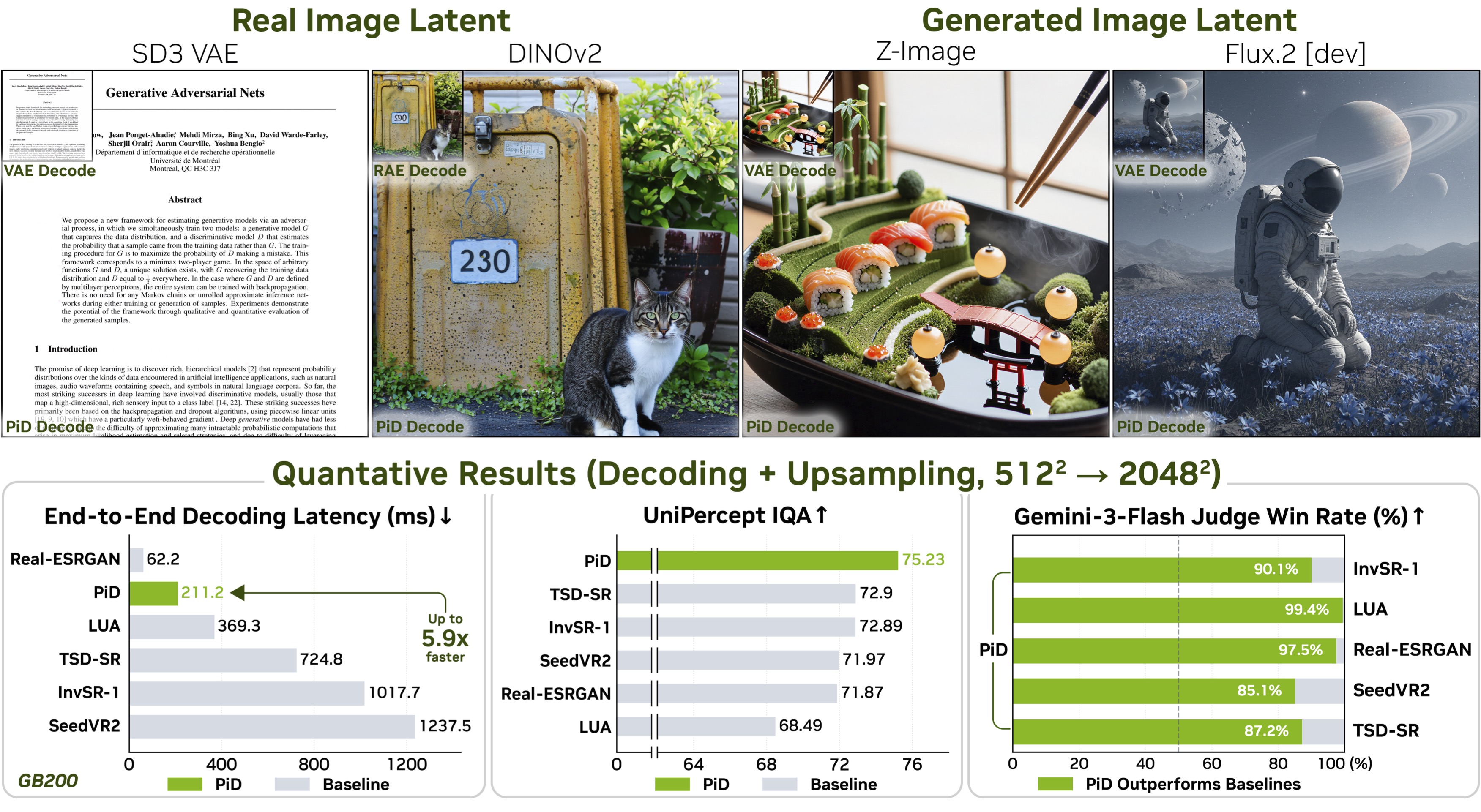
Most diffusion models do not work directly in pixel space. They generate in a compressed latent space, then decode to pixels at the end — and that final decode step is often where micro-artifacts, softness, and color drift appear. NVIDIA PiD (Pixel Diffusion Decoder), released publicly in May 2026, replaces that decoder with a conditional diffusion module that generates detail while upscaling.
How PiD works (simply)
PiD does not generate images from scratch. It is a graft module for existing pipelines — FLUX.1-dev, FLUX.2-dev, SD3 medium, and others. Low-resolution latent output enters PiD; a distilled 4-step diffusion pass produces sharp 2048px or 4K results. Decoding and super-resolution are fused into one pass.
Performance highlights
- All PiD checkpoints distilled to 4 steps — fast despite high resolution
- 2K variant: low-res latent → 2048px (×4 or ×8 depending on backbone)
- 2K-to-4K variant: 1024px latent → ~3840px output
- Compatible with multiple aspect ratios and existing VAE stacks
What it means for creative studios
PiD signals where image quality is heading: the bottleneck may shift from the latent generator to the decoder. For Bellucci Studio workflows built on FLUX and ComfyUI, this is worth tracking — sharper native output means less post-upscaling and fewer artifacts in campaign stills and key frames before video animation.
The real question is not whether PiD is a new image model — it is whether quality bottlenecks shift from latent generation to the decoder. NVIDIA is betting yes.
Important caveat: PiD ships under NSCLv1 — research and non-commercial evaluation only. No production use or output resale today. Setup requires Python scripts and a capable GPU; ComfyUI integration is not yet mainstream. Watch this space — the architecture is more relevant than immediate deployment.