Google launched Gemini Omni Flash at I/O 2026 — a multimodal video model embedded across Gemini, YouTube Shorts, and Flow. The pitch: any input to video. The reality, after hands-on testing and community benchmarks, is more nuanced.
What Google promises
- Text-to-video, image-to-video, and audio-to-video generation
- Conversational video editing — modify scenes through multi-turn chat
- Flexible inputs: sketches, graphs, photos
- SynthID watermark on every output · 10-second clip limit by design
Raw generation quality: Seedance still leads
For text-to-video from scratch — complex motion, physics, cinematic VFX — Seedance 2.0 remains significantly ahead. We also tested video-to-video editing: asking both Seedance and Omni Flash to add a massive wind effect to an existing room scene. Even for editing, Seedance performed better in our comparison.
Where Omni Flash actually differentiates
- Chat-based editing — no other model supports multi-turn conversational video refinement in a familiar LLM interface
- Distribution — embedded in Search, Gemini, Flow, and YouTube; hundreds of millions of users without seeking a dedicated tool
- Gemini reasoning integration — strong for quick educational clips and tutorial-style content
Production considerations
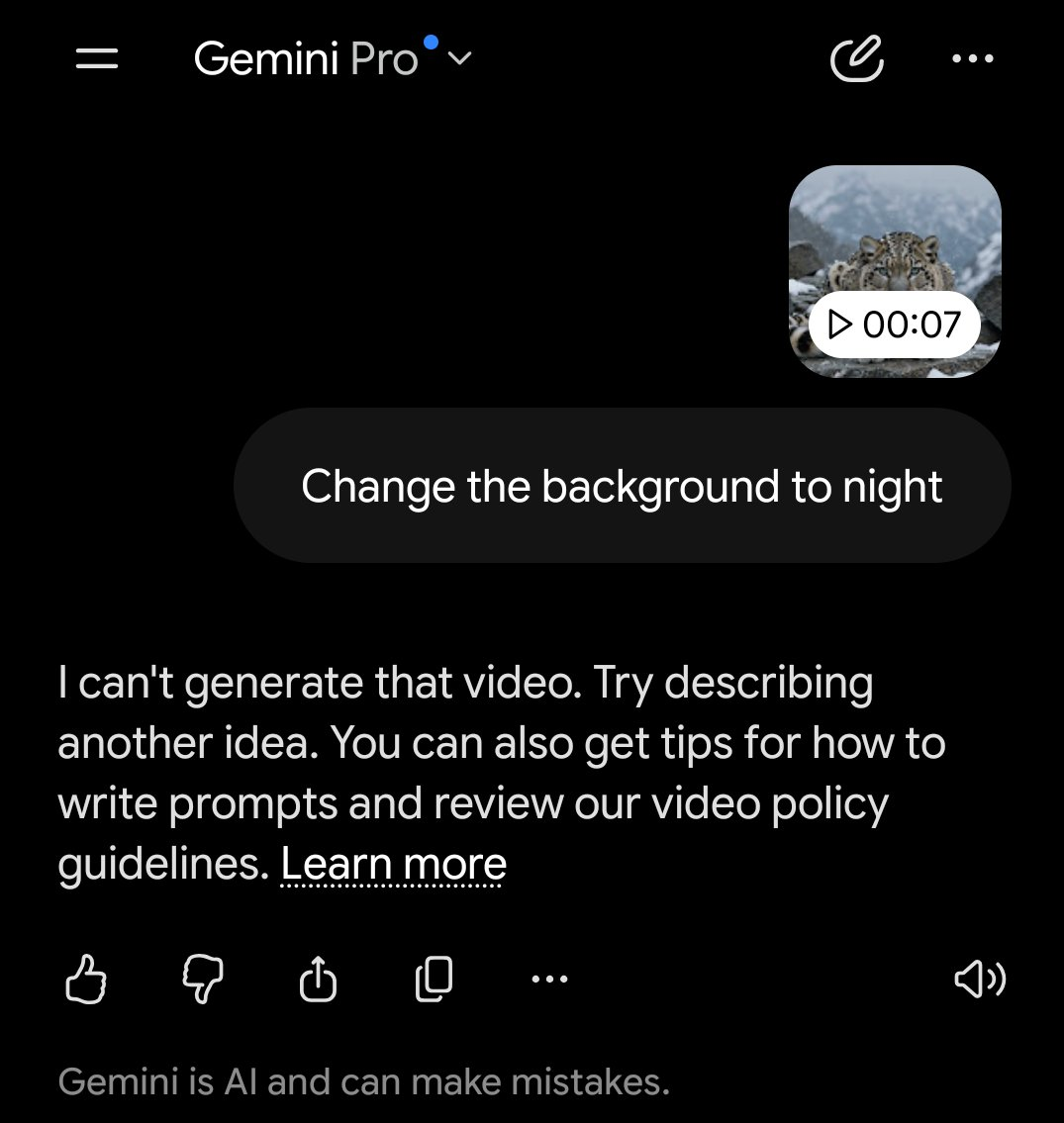
Quota is tight: two video generations can consume ~86% of a daily AI Pro allowance. Safety refusals are frequent — Google may have shipped before the model was fully production-ready. Omni Pro is announced but not yet available.
The question is not "Is it better than Seedance?" — it is whether removing the prompt-engineering barrier brings a new wave of creators. Probably yes.
Verdict for studios: Omni Flash is not the best raw video model, but it may become the most used by the general public because Google removed the prompt-engineering barrier. For premium campaign work, Seedance and directed pipelines still win on quality.